Friday, November 2, 2012

Climate Changes, Weather and Catastrophe

Questions Answered by the 8th grade student Zoe Bertol-Foell

How does climate change effect weather?
In a simple phrase, climate change increases temperature. This increase is a result of the greenhouse effect. The greenhouse effect is when long wavelength radiation gets trapped in the atmosphere causing the increase in temperature. A classic example of this is when the interior of a car gets heated on a sunny day.  As humans over the years have been burning more fossil fuels, more carbon dioxide is being released into the atmosphere. Carbon Dioxide is strongly absorbent and it doesn’t allow much heat to escape into space. Since 1970, the overall temperature of the surface of the ocean has increased by one degree Fahrenheit. One degree Fahrenheit may not seem like much but it can cause deep concern. Increased temperature results in fast evaporation which causes more precipitation. Ironically, it can also lead to droughts in some areas because a warmer atmosphere can hold more water.

Has hurricane Sandy been effected by climate changes? 
Hurricane Sandy was the largest storm that New York City has ever recorded.  She had left thousands of New Yorkers devastated without power or shelter and she even took away lives of children and families. Cost estimates are predicted to be 20 billion dollars in damage. Hurricanes thrive on heat unlike tornadoes. A warmer ocean means more energy for a more powerful hurricane. As much of 10 percent of Sandy’s energy could have been a result of global warming.

What is the carbon footprint?
Carbon footprint is the amount of carbon dioxide that humans or man-made objects leave in the atmosphere. Vehicles that use more fossil fuels such as planes and trucks leave a bigger carbon footprint. Humans should try to limit their carbon footprint as much as possible. They can do so by a number of easy steps such as; carpooling, taking public transportation, or bicycling. If you live in New York City, a great way to reduce your footprint is to start commuting by subway. Since subways function off of electricity mostly, it leaves a very small carbon footprint compared to cars and planes.

What can be done by government?
 The government could help by supporting renewable energy generation. With proper funding, America could build windmills and solar panals to replace coal which produces high amounts of carbon dioxide. New York City has taken steps to reduce its carbon footprint by eliminating all non-hybrid taxis. A law was recently passed that prohibited cars from idling near school grounds for more then one minute. Big companies such as Wal-Mart can also help by designing their buildings to let in more sunlight so they could use less electricity during the day.

What can be done at individual level? 
One individual can not change global warming but if many communities participate, we together can take simple easy actions to try to reduce global warming as much as possible. A great way to help is to reduce your carbon footprint by changing your ways of transportation as mentioned before. There are also many ways you can help out at home. Get into the habit of turning off a light when not needed or turning off the faucet while brushing teeth. When you aren’t charging your phone or laptop, unplug the charger and always try to buy energy star appliances.

Wednesday, October 31, 2012

Post Sandy Thoughts | Cities and Nature

The first sunlight in NYC after the storm
This morning I witnessed the first sunlight from the almost apocalyptic storm which hit New York City. The sun, going in and out of clouds, was shining on the trees outside my bedroom and brought reassurance, calm and joy. Yet the memories of the past days were daunting together with many questions about how much of the storm was due to abuse of nature in human activities. The use of nature by human interventions can be harmoniously achieved in respect with the environment creating a symbiotic relationship between man and nature. But in the past century use of nature as been transformed into abuse, causing alterations in the environment harmonious functioning such as climate changes.


New York can be considered a city of extremes: the city which never sleeps, were bright lights are on 24 hours a day, creating a waste of electrical and human power in pure entertainment based activities. People functioning is based on circadian rhythms of wake and sleep patterns, and sleep requires darkness.  New York is also a city of extreme economical inequality where a minority of extremely wealthy individuals from the main financial institutions controls the economy and policy. So extreme are the height of its building and the density brought by the ratio of height over square footage of urban land. Extreme density brings congestion in transportation. The extremes in building demolitions and constructions are also characteristics of New York city streets. Relentless unregulated construction creates excessive waste and air pollution generated by both demolition and new construction itself. Coming from Rome, a city where buildings have been used often for hundred of years, I am shocked about the short life and building cycles in New York neighborhoods. As a pedestrian — I use walking as my main transportation means— I am constantly exposed to debris, dust and poor air quality. The impact of Sandy on the city infrastructure has shown how lack of common sense and abuse in building construction is having disastrous consequences in the urban life.

Water, air, fire and earth were considered the primary elements constituents of the universe in many different cultures from both Eastern and Western traditions. Quite ironically all of the four elements were the agents of the destruction of the built environment brought by Sandy. The encounter between earth and water —in geographic terms the coast where the ocean meets the land— was considered a sacred place by many ancient cultures; contemporary human arrogance has been erecting building on the furthermost limits of the coastland often for only private use. Beachfront property comes with a high price tag attached, now this real estate economic valued has been challenged and often destroyed by nature itself.

Is Sandy teaching a lesson of how the respect of mother nature cannot be ignored for any human settlement and use of land?

"The Sun Also Rises"

Tuesday, October 30, 2012

Sandy, the Morning After | Water Wind Earth Fire


A fallen tree by the American Museum of Natural History
It is a gloomy day dominated by a plumbeous sky in NYC. It is the morning after Hurricane Sandy path crossed the city going over the already high disaster expectations:
  • a record storm surge of 13 feet, aided by full moon
  • winds gusts to over 70 mph in the Rockaways and other areas in the Five Boroughs
  • Power outage for at least 650,000 households in New York and Westchester by early am this morning — 250,000 in only Manhattan at the pick of the storm.
  • Forced evacuations for up to 375,000 people in the New York City's Zone A
The world looks different; even the Upper West Side, which is one the Manhattan neighborhoods least effected by the storm, seems to be out of a scene from a science fiction movie, where empty streets covered by leaves, fallen brunches and even trees.

Fallen trees are nature casualties from yesterday a battle between water, wind, earth and fire, in the city where human greed dominates and money. And sadly, fallen trees are the main cause of human casualties. Quite ironically and almost iconically the dandling crane at 157 West 57th Street, was one of the most visible announcement of Sandy's arrival: the crane was aiding in the construction of one the most expensive residential real estate in the world.  Al Gore stated in his blog how Hurricane Sandy is related to global warming: “Scientists tell us that by continually dumping 90 million tons of global warming pollution into the atmosphere every single day, we are altering the environment in which all storms develop. As the oceans and atmosphere continue to warm, storms are becoming more energetic and powerful. Hurricane Sandy, and the Nashville flood, were reminders of just that.” So many other natural disasters are related to global warming and other human caused environmental decay; perhaps the devastation brought by Sandy should remind us that money can buy almost everything but for nature.

Unseasonal leaves on trees (global warming?) caused branches to fall for the strong winds

A deserted Central Park West
Another tree casualty in Central Park, still closed

A tree is a symbol of strength, life and harmony, extending from the earth to the sky

Monday, October 29, 2012

Recording Sandy

October 29
12pm NYC looks like a ghost city
It was quite unusual at noon to see many establishments closed in the city which never sleeps, even in one of the safest areas, the Upper West Side. From restaurants and delis to larger stores, museums, subway entrances and even the city green artery, Central Park, there was the same sign posted on the locked doors: closed.


8pm EDT: 
The roof of the water tank of the building just flew off, fallen trees in the street...and this one of the safest area in NYC


Sunday, October 28, 2012

Mapping Sandy

While I am respectfully (and fearfully) waiting for my personal encounter with Sandy, when the hurricane will intersect my axis mundi, I am sharing images and useful links.

Credit: NOAA's GOES-13 satellite  Oct. 28 at 1302 UTC
Credit: NASA GOES Project
NYC Evacuation Zones

Friday, October 26, 2012

Vernissages | Bodyspace at Sean Kelly

On my way to the opening, a view of midtown skyline, from Tenth Avenue
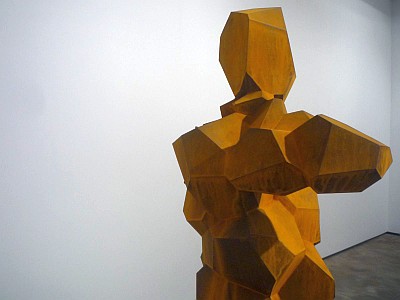
Antony Gormley's three-dimensional steel work "Bodyspace" inaugurated the relocation of Sean Kelly new space, on Tenth Avenue.
Sean Kelly's new space occupies former Exit Art location; the historical not-for profit gallery sadlyclosed a few month earlier, following Jeanette Ingberman's passing in 2011. The last Exit Art exhibition was metaphorically titled "Every Exit Is an Entrance".

Sean Kelly's new space, formerly "Exit Art"
A quite different intention and scene in the new commercial gallery, representing many international art celebrities... My visual memories of the evening:


Friday, October 19, 2012

Vernissages | Chelsea, October 18

My favorite exhibition of the evening was  Gulay Semercioglu "Variations on Line" at Leila Heller Gallery. The three-dimensional work features complex geometries fabricated with simple materials —wood panels,  wire and nails— which interact with light, generating kaleidoscopic visual labyrinths.

 Gulay Semercioglu "Variations on Line" @ Leila Heller Gallery


Chuck Close @ The Pace Gallery