Saturday, December 15, 2018

exhibitions | New York: "Norman Lewis: Looking East"


Michael Rosenfeld Gallery presents its fifth solo exhibition of the late American abstract expressionist Norman Lewis (1909-1979). The exhibition titled "Norman Lewis: Looking East" offers a less known aspect of Norman Lewis' work dated from 1948 to 1974, including paintings, works on paper and artist sketchbooks (on loan from the Norman Lewis Archive). The works, as well the thought process shown in the sketchbooks reveal the major influence of Eastern thought and art on Norman Lewis' art and life. 

The exhibition was important and for me extremely inspiring, in the transition between art involved with social themes to more abstract universal themes. The title itself "Looking East" seems to have a double meaning from the literal reference to Asia to perhaps East as the direction of sunrise. The calligraphy in pantings bears resemblance with particle physics diagrams, reminding me of Richard Feynman's diagrams depicting mathematical relationships of subatomic particle—perhaps not by coincidence, considering the profound relationship between contemporary physics and Eastern thought, which was explored in the sixties and seventies. The artwork seems also to add an aesthetic dimension to the investigation of language and archetypes. As stated in the MRG press release for the exhibition
Many avant-garde artists of Lewis’ generation looked to Asian thought and aesthetics “to forge an independent artistic identity that would define the modern age – and the modern mind – through a new understanding of existence, nature, and consciousness.”[1] Artists in Lewis’ circle, amongst them Mark Rothko, David Smith, Ad Reinhardt, and Adolph Gottlieb, drew ideas from Eastern religions, Zen Buddhism and Carl Jung’s theories on the unconscious.
The different type of work in the exhibition brought to the attention the thought and art process in Norman Lewis, The artist is better known as "the sole African American artist of his generation who became committed to issues of abstraction at the start of his career and continued to explore them throughout his lifetime. Lewis’ art derived energy from his vast interests in music – both classical and jazz - as well as nature, ancient ceremonial rituals, and social justice/equality issues central to the civil rights movement." Lewis' artistic commitment to social justice is renown as founding member of the Spiral Group, and his teachings in HARYOU-ACT, Inc. (Harlem Youth in Action) "an antipoverty program designed to encourage young men and women to stay in school."


Reminding Feynman Diagrams
Sketchbooks and books


Friday, November 9, 2018

Vernissages | Louise Bourgeois "Spirals" at Cheim & Reid


The spiral is an attempt at controlling the chaos … It has two directions. Where do you place yourself, at the periphery or at the vortex? 
 Louise Bourgeois

Spirals have been a recurrent theme, not only for Louise Bourgeois, but for many other artists, including myself. The form, which seems to be contracting or expanding according to the rotation direction, is hypnotic and intriguing, a metaphors and literal representation of a multitude of concepts including time.


Tuesday, November 6, 2018

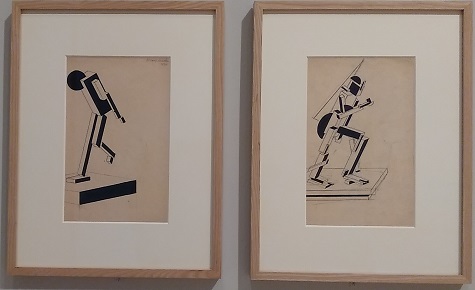
Exhibitions| New York: "Chagall, Lissitzky, Malevich: The Russian Avant-Garde in Vitebsk, 1918-1922"


An important exhibition on a lesser known chapter of the Russian Avant-garde is currently on view at The Jewish Museum. "Chagall, Lissitzky, Malevich: The Russian Avant-Garde in Vitebsk, 1918-1922" includes works and documentations from  the People’s Art School, with was started by Marc Chagall in his native city of Vitebsk in 1918. The exhibition includes mainly works from Marc Chagall, El Lissitzky and Kazimir Malevich, but also works from lesser known artists who were part of the school.
Chagall was appointed Fine Arts Commissioner for the Vitebsk region in 1918, and in his role was enable tp start an art school "open to everyone, free of charge and with no age restrictions. The People’s Art School was the perfect embodiment of Bolshevik values, and was approved in August 1918." 
 "Chagall, Lissitzky, Malevich: The Russian Avant-Garde in Vitebsk, 1918-1922" is an international joint collaboration by the Paris Centre Pompidou and the New York Jewish Museum.

El Lissitzky and kazimir Malevich, summer 1920
David Yakerson and his works

Friday, September 28, 2018

Vernissages | New York: Leonor Fini at Museum of Sex


A comprehensive exhibition of works by Leonor Fini (1907–1996) opened yesterday at the Museum of Sex in Manhattan. The Argentinian surrealist artist integrated different media in her oeuvre, characterized by depictions of  women: paintings, drawings, photographs, film and furniture. The artwork was accompanied by archival material and presentation of costumes. The archival film footage was particularly intriguing recording what in contemporary language can be defined as "performance art". The exhibition was "framed" in red velvet, which, in the theatrical dark lighting, greatly contributed to present the extreme sensuality of the drawings and paintings.


Thursday, September 27, 2018

Exhibibitions | New York: KIRSCHENBAUM at Postmasters


An outstanding exhibition of the late Bernard Kirschenbaum (1924 - 2016) is on view at Postmasters. The works on the display date from the years 1966 to 1981, and include "monumental and experiential sculptures and installations." I found extremely intriguing the actuality of  Kirschenbaum's in large part referring to computational systems, geometric structures and parametric assemblies.


Saturday, September 8, 2018

Vernissages | Fall Season in New York: First Week

"Truth & Beauty" at Michael Rosenfeld Gallery
“To open man’s eyes to the world, to enable him to see beauty, to better understand reality, and to have a closer affinity with truth... beauty, reality and truth are the philosophical basis for my work.”   —Ebony, July 1967
The fall season has officially opened in New York, and these are my picks for the first week of September 2018, which promises a quite dense and diverse array of exhibition. The quote from Charles White (1918-1979) important exhibition at Michael Rosenfeld Gallery is a comforting general statement going beyond art and especially meaningful in these unsettling times.

Another important posthumous exhibition of Lygia Clark (1929-2004) also resorts to beauty, here more abstract as the beauty found in geometric constructions. The artist was one of the most influential representatives of the Brazilian  Neo-Concrete Movement (1959–61). The extensive exhibition of Pape's work at Hauser & Wirth—including sculptures, drawing and writings—  motivated me to read more about the Neo-Concrete Movement, and its manifesto, written by Ferreira Gullar. Below are some excerpts which are well represented by the work in the exhibition: 
We do not conceive of art either as a “machine” or as an “object” but as a quasi-corpus, that is, an entity whose reality is not exhausted in the external relationships of its elements; an entity that, though analytically divisible into its parts, only gives itself up fully to a direct, phenomenological approach. We believe that the work of art overcomes the material mechanism upon which it rests, not due to some virtue lying outside this Earth: it overcomes it by transcending those mechanical relationships (which is the object of Gestalt theory) and by creating for itself a tacit signification (Merleau-Ponty) that emerges in it for the first time. If we had to search for a simile for the work of art, we could not find it, therefore, either in a machine or in objects taken objectively, but rather, as S. Langer and V. Wleidlé [sic] argue, in living organisms. Furthermore, this comparison would not be sufficient to express the specific reality of the aesthetic organism.Since the work of art is not limited to occupying a place in objective space—but rather transcends it in basing a new signification in it—the objective notions of time, space, form, structure, color, etc. are not sufficient to understand the work of art, to fully explain its “reality.” The lack of an adequate terminology for expressing a world that does not succumb to notions led art critics indiscriminately to employ words that are unfaithful to the complexity of the created work. The influence of technology and science was manifest here as well, to the degree that today, with their roles reversed, certain artists, confused by that terminology, attempt to make art starting from these objective notions in order to apply them as a creative method. Inevitably, the artists who work in this fashion only reveal a priori notions, since they are constrained by a method that already prescribes the results of their work before they begin. By avoiding intuitive creation, by reducing himself to an objective body in an objective space, with his paintings the rationalist concrete artist hardly demands, from himself and from the viewer, a stimulating and reflexive reaction. He speaks to the eye as an instrument and not to the eye as a human means of possessing the world and of giving oneself to it; he speaks to the machine-eye and not the body-eye.

Bold geometric investigations of Lygia Pape at Hauser & Wirth (East 69 Street)

More geometric exploration can be found at David Richard Gallery in the exhibition "Systemic Pattern Painting", including works by a group of artists from the 1970s and 1980s Criss-Cross cooperative, based n New York City and Boulder (Colorado). Criss-Cross artists "explored complex mathematically-derived patterns and abstract structures. The cooperative was part of the broader Pattern and Decoration movement from the 1970s."

 "Systemic Pattern Painting" at David Richard Gallery

"NeoRealismo: The New Image in Italy, 1932" at Grey Art Gallery (NYU)

Emilio Cavallini, Meguru Yamaguchi "Untainted Abstraction" at GR Gallery

Lower East Side "Confirmation Bias" at bit forms gallery

"Superimposition" at Lesley Heller Gallery

"Urs Fischer: Play" at Gagosian