Showing posts with label Buddhism. Show all posts

Monday, May 19, 2014

exhibitions | Michael Morgan "Impermanent Vessels - Rebirth"

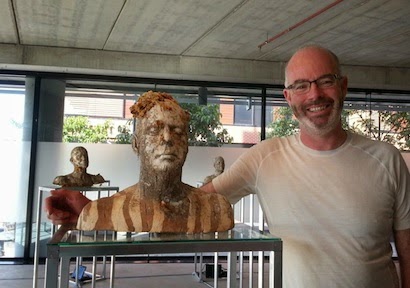
One of the fifty head/vessels. Photo by Michael Morgan
During my daily walk to the Waterfront Campus I encountered Michael Morgan's "Impermanent Vessels - Rebirth" an exhibition important for its content and remarkable for the beautiful multimedia installation. A very unusual dialogue of video projections, sculpture and sound installation (the Muslim Call to Prayer) brings to life the notion of replication of the self (the artist's head) subject to time in space. The two-year project  (2012 to 2014) is a an artist meditation on "the transient and evolutionary nature of all aspects of existence and life."  


More from the artist statement: 
The Story of Vessels
50 copies of the artist's head produced in raku clay, significant through its use in Japanese tea ceremony, were placed in five locations along Corio Bay and Port Philip Bay - Swan Bay, Wedge, Point Lillias, Welsh's Jetty and Point Henry Back Lead. The vessels were subject to nature's forces to transform them through interaction with underwater environment.One year later, the artist began to recover the vessels leaving at least one at each site to symbolize the ultimate return of all things to nature. A total of 38 vessels have been recovered, while others were missing or left to continue their journey.
The Exhibition 
The exhibition presents the recovered vessels and the existence (or non-existence) of the lost vessels by the coordinates of their sites.The small screens rotate the images of vessels at four stages of their evolution: upon production, just as they were placed underwater, then a year after placement underwater, and finally after recovery in their present state.The vessels reflect the unavoidable change in the light of fundamental connectedness of all things as described in Zen Buddhist teachings. Fragile and impermanent- they are also the 'vessels of life' and part of something beautiful. The Muslim Call to Prayer is the spiritual reference to the sound resonating in vessels. A digital projection onto sculpture features the artist wearing hard hat diving equipment with the sound overlay of breathing and heartbeat as the helmet represents the 'vessel sustaining life'.'Impermanent Vessels - Rebirth' is artist's dedication to his late wife Carolyn.
The heads/vessels in the artist's studio. Photo by Michael Morgan
Excerpts from the opening address by Dr. Felicity Spear:
The entire cosmos is a cooperative. Lord Buddha was spot on when he made this observation all those hundreds of years ago, and while contemporary science also finds this to be true, and Michael and I would agree, sadly the politicians who run our lives mostly ignore it. Michael has had enough experience of life to understand something of the nature of this cooperative interconnectedness between things, but also the way things always change, how nothing stays the same,'how everything is in a state of flux. This exhibition Impermanent Vessels- Rebirth could be described as an autobiography in which Michael. through the experience of the tragic loss of his wife Carolyn, attempts to come to terms with the fragility and impermanence of life. His fifty vessels pay homage to the journey he has made in coming to understand the underlying web of connections between all things and their transient nature.Working with his own image, Michael has created what could be described as self portraits, fifty of them, one for each year of his life. He refers to them as vessels of life, fragile, subject to change, impermanent. He draws together the strands of time, memory and transformation in a process which he likens to archaeology, where objects scarred and marked by time are rediscovered, retrieved and rebirthed in another time. The transformative elements in Michaels' work are expressed through the tactile materiality of raku clay, its weathering over time beneath the sea by the flow of water and weed, and the experience of diving in a silent womb-like world.Beneath the sea he returns to an intimate world, connected like an umbilicus to a life line above, hearing only the sound of his own breath and heartbeat, and the flow of water over his body. Retrieving these vessels after a year in their underwater locations enabled their rediscovery, their reinterpretation and their rebirth. They reveal the changes that time has wrought on their surfaces by the process of chance. They are the material evidence for the inevitability of change and its unpredictability.To be an artist takes courage and perseverance. Artists who push the boundaries step outside the mainstream and dare to see the world with other eyes. This can be challenging or fascinating for we cultural consumers depending on what we bring of ourselves to the experience. But for an artist it is not only about courage. It's about a certain sensibility and sensitivity, it's about being attuned to things, and it's about the need to transform experiences into images while drawing attention to different ways of viewing the world. Michael's work raises our awareness of something absolutely fundamental about the cosmos and our own experience. It reminds us that we are more alike than different. We are all in the same boat. He engages with and celebrates the Buddhist observation of the cosmos as a cooperative, the melancholy beauty of the Muslim call to prayer, and the rationality of western science which demystifies the physical world. In doing this he pays respect to cultures other than our own and acknowledges our shared human experiences. This is the legacy of these thoughtful and beautiful vessels as they interact with each other and play with light, our medium of contact with the cosmos. They reflect Michael's courage, his determination and his talent.

Michael Morgan "Impermanent Vessels - Rebirth"
Deakin University Geelong Waterfront Campus
9-25 May 2014

Friday, June 1, 2012

NYC, World Science Festival | How We Bounce Back: The New Science of Human Resilience


How do humans recover psychologically from trauma? As part of the World Science Festival’s multi-disciplinary look at scientific research today, this was the subject of a panel discussion at the Tishman Auditorium at the New School. The panel of experts included George Bonanno, Clinical Psychologist at Columbia, Dennis Charney, Biological Psychiatrist at Mount Sinai, Fran Norris, Social Psychologist at Dartmouth, Mathieu Ricard, Buddhist Monk, and moderator, Bill Blakemore of ABC News. Debate was dovetailed with a series of short videos documenting personal stories of tragedy and how the individual found a road to recovery. Panelists debated innate versus learned behaviors and discussed a full range of solutions from meditation to pharmaceuticals.
David Foell

Sunday, October 2, 2011

Events | Won Dharma Center Opening

Today the US facilities of the Won Dharma Center opened with an official ceremony and service, attended by almost a thousand of people, including pratictioners as well as
visitors; many practitioners come from this event from Korea, where Won Buddhism originated.


The center is located in the Hudson Valley, in the town of Claverack; it is only five miles from Sun Farm, and less than 100 miles from other main spiritual centers in this area, including Kripalu (Stockbridge, Ma), Tendai, Zen Mountain Monastery (Mount Tremper, NY), Tendai Buddhist Institute (Canaan, NY).
As Robin Andrews, the Claverack town supervisor mentioned in her ceremonial speech, the Claverack name is the contraction of the Dutch word for "Clover Fields" and the clover leaf has a widespread symbolism, welcoming the new center focus on peace.


The name Won Dharma Buddhism comprises the words Won meaning ‘circle’ which symbolizes the ultimate reality or our true nature. From the Won Dharma Center mission:
 The Three Jewels in Buddhism are:  Buddha, Dharma and Sangha.  These are the refuges where practitioners find true peace and freedom.
Buddha means the awakened one, the embodiment of the truth within ourselves.
Dharma is the teaching of the realized one; it is the path to restore our true self or inner light.
Sangha means the spiritual community or an assembly where like-minded people live, study and practice together for a common purpose.
To learn more visit the Won Dharma Center site

Sunday, September 25, 2011

Events | Lecture by Tibetan Bon Lama Tempa Dukte at the Spencertown Academy


Today the Spencertown Academy hosted a lecture presented by Eight Branches Healing Arts:
The Intimate Mind: Illuminating Emotion & Transformation. Public Talk & Book signing With Tibetan Bon Lama, Tempa Dukte. The Intimate Mind is our natural potential to provide space to let everything manifest in its own way. It is the practice of Open Presence through which we can experience the miracle of each moment. However, our divided mind creates obstacles that do not allow us to abide in this experience. Tempa Lama will talk about overcoming these obstacles through a practice of gentleness and awareness.  Tempa Dukte Lama is an ordained Tibetan Bon lama. He is an artist, poet and writer, and the founder and spiritual director of Olmo Ling Tibetan Bon Center in Pittsburgh, PA. He trained in Menri Monastery, India under the guidance of H.H. 33rd Menri Trizin, the spiritual head of Bon. He teaches in the US and Europe on healing and other Bon practices, being with dying, meditation, and the path of compassionate beings.
Tempa Dukte Lama, a soft speaking Tibetan Monk, engaged the audience with his smile and kindness. These are the topics which I found most captivating:
  • Everything comes to an end. 
  • Accept impermanence of life and being here and now. 
  • Search for happiness finding your own personal meaning and needs. 
  • Embrace flexibility. 
  • There are three demons: attachment anger ignorance. 
  • To change your life change your thinking into positive. 
  • Express joy and happiness in what you do. 
  • The mind is consciousness. 
  • Be patient. 
An uplifting lecture, greatly needed after the sad and unsettling event of the past week.

Thursday, September 15, 2011

Events | "Spiral Music" and Film on Buddhism at the Rubin


The Rubin Museum’s series Spiral Music once again presented transcendent sounds in the playing of Max ZT on the dulcimer and Sam Sadigursky on the flute last evening (9/14/11).


Max ZT may indeed be lauded as the “Jim Hendrix of Hammered Dulcimer,” but in the playing we heard, the transcendent overshown the fiery and the improvisatory sounds led, but didn’t hammer on our psyches. This was the duo’s first collaboration, and we hope that we will more.

Following the music, the Rubin’s film series presented To Be A Buddhist Nun, the New York Premiere of "In the Shadow of Buddha". Shot by Heather Kessinger, the film took us to the seldom-seen world of Buddhist nuns in Tibet and refugees in Ladakh, a region in northernmost India.

Most of the nuns were old, wrinkled and with missing or deformed teeth, visual images seldom seen on movie screens. Although shown with prayer wheels or in services, or with prayer wheels, in their words the nuns lamented their lack of education and their second-class status in this Buddhist tradition. “A woman who has been a nun for 100 years must bow to a man who has been a monk for only one day”.

Monday, September 5, 2011

camminando | Sunday Afternoon in Columbia County: "Festival of Books" and Won Dharma Center

Sunday afternoon was quite dense of events in Columbia County. My walkabouts (or to be more honest, "driveabouts") started at the Festival of Books at the Spencertown Academy, the 1847 schoolhouse.
The 2011 Festival of Books is the sixth annual "celebration of books and reading for the whole community"; the program featured a series of events, from best selling author readings to an exhibition of artwork from one a presented books and even sale of vintage books —where I found a 1865 edition of Lord Byron's Poems. It gives me a great pleasure in these years of digital everything to actually touch and read a vintage book, being amazed of how the delicate thin paper with elaborate illustrations and bound in an elegant leather cover, witnessed the passing of centuries and who knows how many stories can narrate...

Artwork from Howard Saunders's “faux graphic memoir ”Axeman Who Will be 70 in the Year 2010"

The afternoon continued at the open house of the Won Dharma Center: a presentation to the Claverack community of the new facilities of the United States headquarters of Won Buddhism Sangha. Won Buddhism is based on the teaching by the Korean born founding Master Sotaesan, who reached enlightnemt in 1916: "After reading the Diamond Sutra, Sotaesan said, "Shakyamuni Buddha is truly the sage of sages."

The Won Dharma Center meditation hall and grounds also featured an art exhibition by Bruno Pasquier-Desvignes, whose work is often based on aesthetically interesting assemblages of found manmade and natural objects :


The facility is set on 465 acres of the rolling hills on the North side of Route 23, near the Claverack Red Mills, offering breathtaking views of the sun setting behind the Catskills Mountains. On the architectural critique note, the series of building —a meditation hall, an administrative building, dining hall and residencies— although inspired by sustainable design and beautifully detailed in cedar and local materials, lack a master plan. Mainly an integration with the land and overall landscape design are missing; the site as well as the Buddhist tradition, relating the human mind and body to nature, would have offer a great opportunity to create an architectural expression / integration with the landscape.


Nevertheless the Won Dharma Sangha presence is a great addition to the energy of the already locally present spiritual communities and practices.

Nature and Spirituality: the Sun Setting behind the Catskill mountains

Tuesday, January 18, 2011

Thoughts | Cross Country Skiing and Buddhist Change


Views of Sun Farm while skiing

“Everything changes, nothing remains without change.”
Gautama Siddharta,563-483 B.C.

Buddhist thinking focuses on change and transformation as characteristics of reality. It is in the Buddhist philosophy and spiritual practices. I always understood this essential interpretation of reality at an intellectual level but only recently I have started to experience at a personal level how adapting to change is the most fulfilling way of living. It so not as easy for me as I make it sound, a very bumpy road with a lot of switchbacks, just to use a quite common metaphor. But still learning to appreciate the possibilities instead of following out of reach desires, can bring unexpected and rewarding surprises.

A few days ago I had a quite important experience which may sound very banal: A few days ago I had a quite important experience which may sound very banal: for the first time in nine years I wore a pair of skis and went cross country skiing.

On February 17 2002 I had a major down hill injury, caused by somebody else (not by surprise he is a partner in a large NYC corporate architectural office) lack of attention, which resulted in a broken femur, 3 surgeries, 6 weeks on a wheelchair, intense physical therapy. Although I totally recovered, reaching a fitness level higher than before the injury, I was totally terrified about skiing.
Until I finally reached the conclusion that downhill skiing was not the right activity: not only for the implicit great risk of being victim of accidents because of somebody else's carelessness, but because is highly invasive of the natural landscape and not sustainable. At this stage of my life I am trying to be very sensitive to environmental concerns so even without the fear caused by the accident downhill skiing would not be appropriate for my ecological awareness.
So I for the first time in my life I tried cross country skiing, and really enjoyed the peacefulness and closer connection with nature brought by this winter activity.