Showing posts with label Italian Academy. Show all posts

Monday, February 10, 2014

Tracking Creativity: the Default Mode Network

I attended with great interest the symposium "The Default Mode Network in Aesthetics and Creativity"  which took place on February 7 at the Italian Academy of Columbia University. My expectations were to find leads to the biological definition of human creativity and also to learn about methodologies to identify creative thinking and "measure" it; methodologies which I could have used or at least reference in my PhD research "Form Mind Body Space Time". I also hoped that the symposium presented content across different art and science practices from an interdisciplinary perspective. 
The symposium was opened by the introductory remarks of the two conference organizers: David Freedberg, the Pierre Matisse Professor of the History of Art and Director of The Italian Academy for Advanced Studies in America of Columbia University, and Gabrielle Starr, the Seryl Kushner Dean of the College of Arts and Science and Professor of English: Professor Freedberg mentioned how the DMN is a relatively new area of studies in neuroscience and himself has not heard of its relevance until very recently; the prominence and almost sudden popularity of the related research prompted him to organize the symposium.

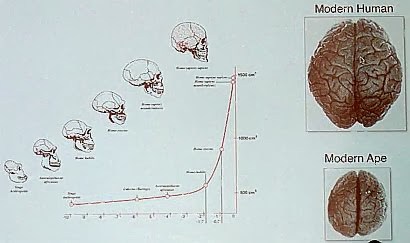
Randy Buckner, principal Investigator of the Cognitive Neuroscience Laboratory (CNL) and Professor of Psychology at Harvard University and member of the Center for Brain Science, opened the morning session with "The Evolution of the Default Mode Network". The presentation started with the ambitious question: “What Makes Us Human” and explored the evolution of brain in primates; particularly emphasis was in the role of memories and linking past present and future in the sense of self.
Randy Buckner "The Evolution of the Default Mode Network"

 Nathan Spreng followed with "The default network and self-generated thought: component processes and dynamic control". Spreng is assistant professor and the director of the Laboratory of Brain and Cognition in the Department of Human Development at Cornell University; his presentation focused on the DMN in memories and social cognition as well as the complexity of brain architecture in network interactions.


From Nathan Spreng 's "The default network and self-generated thought: component processes and dynamic control"

Yvette Sheline, Professor of Psychiatry, Radiology and Neurology at the Perelman School of Medicine, University of Pennsylvania, ended the morning session with “The Default Mode Network in Major Depression: How fMRI Sudies Inform Anatomical, Negativity-Bias and Inter-Network Dysfunction Theories”. The title was very explanatory of the presentation which focused on the relationships between DMN and major depressive disorders (MDD).
Creativity was finally addressed in this presentation: mainly in its relationship with depression. Sheline showed several excerpts on depression from several illustrious “creative” individuals, including Samuel Johnson, Ludwig van Beethoven, Virginia Woolf, Sylvia Plath, William Styron, Kay Redfield Jamison.

DMN, MDD and creativity, from Yvette Sheline
MDD, PTSD and CBT from Yvette Sheline's presentation
The presentation also included case studies on post traumatic stress disorders (PTSD) and the effects of different treatments on the brain imaging on subjects affected by the disorders, branching from pharmacological treatment to cognitive behavioral therapy (CBT).

The afternoon session was opened by Bill Kelley, Professor of Psychological and Brain Sciences at Dartmouth University, presenting “Finding the Self? Insights from the Default Mode Network”. Kelley’s presentation included several images from brain imaging techniques, mainly from functional Magnetic Resonance Imaging (fMRI) — representative of his research on memory and the brain. We learned about Kelley’s research on the biology of memories as well his collaborations with social psychology; of his main research themes is the influence of cognitive, emotional experiences and memories on individuals’ sense of “self”.
Slides from Bill Kelley's presentation

The following presentation titled "What we talk about when we talk about the default-mode network " was a collaborative effort of Daniel Margulies (Professor and Group Leader of the Max Planck Research Group: Neuroanatomy & Connectivity, Germany) and Felicity Callard (Senior Lecturer in Social Science for Medical Humanities at Durham University, UK) . The presentation main questions were “What and where is the default mode network?” “What are the different methods used to probe and delineate it?”. Mind wandering was highlighted as a “core function” of the DMN.

Snapshots from Callard and Margulies' presentation
Rex Jung, Assistant Professor of Neurosurgery at the University of New Mexico and research scientist at the Mind Research Network, followed with the presentation "Networks of Creativity" which I found the most relevant to the symposium theme. He asked, in a humanistic tone, the fundamental question (which was not clearly stated in the previous presentations) “What is creativity?” and answered with the four stages "preparation incubation illumination verification" reminiscent of the early investigations by Henri Poincaré and Graham Wallas. Junk talked about creativity as an evolutionary process and characterized as a mental state where the cognitive domain of knowledge meets the deliberate and spontaneous processing mode. Differently from the majority of speakers —who focused only on fMRI— Jung proposes a multimodal imaging techniques where fMRI is used in conjunction with proton spectroscopy, structural Magnetic Resonance Imaging (sMRI), diffusion tensor imaging (DTI) and EEG. Important areas of investigation were also addressed, such as localization of creativity in the brain and its biological characterization and measurement of creativity from divergent thinking. Jung also emphasized how creativity is a complex cognitive construct involving several neural networks and how it differs from intelligence.
Rex Jung's "Networks of Creativity"
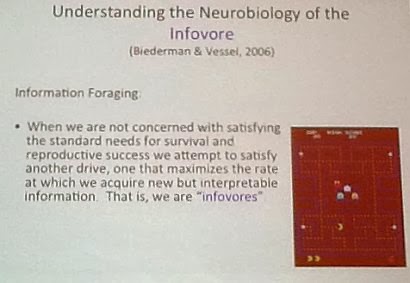
 Edward Vessel,  assistant research scientist at the Center for Brain Imaging at New York University and one of the symposium organizers, concluded with “Art Reaches Within”. His presentation asked the question “What is an aesthetic experience?” He replied with several quotes including  “The beautiful and the sublime taste” by Burke (1757) and "Beauty is the pleasure we attribute to an object" by G. Santayana (1896).
Snaposhots from Vessel's presentation "Art Reaches Within"

Thursday, February 6, 2014

events | Creating Creativity

Art and "science" of phrenology: Erkenne Dich selbst (know yourself)
Creativity has always represented a survival means during the hardship times I experienced several times in my life. For me creativity develop in many modalities and be embodied by several physical media —some of which do not necessarily to aesthetics production. Solving an equation or writing computer programs are creative expressions and often an underlying aesthetics is present in many mathematical and logical cognitive processes.
I am also interested int the nature of creativity and how it relates to the brain morphology and physiology; this interest led me to pursue a PhD on the other hemisphere of the planet, namely Deakin University in Australia. My research "Form Mind Body Space Time" explores the relationship between the aesthetics of human movement and cognitive states; the methodology follows a methodological approach, weaving art and design practices to exercise science and neuroscientific investigations. My objective is to record and measure anedoctal evidence with rigorous experiments —acceptable in scientific terms. One of my research questions is if the mindfulness and aesthetics of human movement, as found in yoga postures to performance arts has influence on mental processes.
My personal research intersect the growing popularity of cognitive sciences in contemporary culture. In the last decades the scientific practices related to neuroscience have expanded from the scientific labs and experiments on mice brain to involve human participation at much greater extents. Probably there are two different developments which are responsible for the broadening of neuroscience among general population: the development of non invasive neuroimaging technology as well as the affordability of electroencephalography (EEG) —the recording of the brain electrical activity. Although the most sophisticated neuroimaging equipment, such as functional Magnetic Resonance Imaging (fMRI), remains in the domain of the scientific community, EEG has become widespread not only in the medical professionals offices but also in homes, mainly for its use in computer games. Neurofeedback and the effects of spiritual practices on the brain have also become the subject of articles and reportage in mainstream media, with photographs of meditation practitioners wearing a EEG headset.
So it is with great anticipation (and expectation) that I will be attending the symposium The Default Mode Network in Aesthetics and Creativity where "leading neuroscientists from top research institutes will gather in New York for a two-day symposium to discuss what the brain is doing when in a wakeful resting state. The DMN – a network of brain regions typically found to be suppressed when individuals focus on their external environment – has been hypothesized to generate spontaneous thoughts during daydreaming and may be crucial for self-referential mental processing, social interactions and the understanding of many neurological disorders."  Tonight keynote speaker Dr. Bill Kelley, Professor of Psychological and Brain Sciences at Dartmouth University, will "present on the Default Mode Network, its history, and our emerging understanding of its function in creative thought."


Saturday, October 22, 2011

Events NYC | Madrigals and Metamorphoses

Out of tune? If your ears like the (artificially) fixed pitch of piano keys, they would have been spinning on your head last Saturday evening as the group Ekmeles presented Madrigals and Metamorphoses at the uptown Italian Academy.


Not everyone’s ears crave such tidiness, and Ekmeles sang their way through a largely 20th-century program of songs by composers known and well-known. But the opening madrigals were by Carlo Gesualdo, a 17th century Neapolitan-born nobleman, murderer, composer. He tuned his music to scales supposedly based on those of the ancient Greeks called “genera”, which leads to intense chromaticism (think pitches between the keys on a modern keyboard).


These were followed by three madrigals by Carl Bettendorf who “decomposed” to various degrees some of Gesualdo’s original music. Folllowing Gersualdo’s model, and in true 20th-century style he added a number of “theatrical” effects, including clapping, laughing, whisperings by the group on the text dealing with Joy and happiness (“Gioia che tutto gioia”). The singers, playing on woodblocks, hammers and metal bowls accompanied their own fine singing.

Thoroughly decomposed was Margin Iddon’s hamadryads. The text was purely phonetic and the pitches were all over the place, relying on heavily experimental tunings. The singers sat at a table as for a banquet, with wine glasses with water at each setting which they used to provide their own accompaniment by running their fingers around the glasses’ rims.

And Elliott Carter, an American composer who will celebrate his 103rd!!! birthday in December was represented by his Mad Regales composed when he was 99 years of age. May we all have such sure-footed creative skills in our 90s. The text by John Ashbery provided the perfect vehicle for Carter’s a capella sextet setting.

Then Peter Ablinger’s Studien nach der Natur took us into the realm of music ecology, where the singers presented sounds of the freeway, the sea, mosquitoes, smoking, a quartz watch, the wind, water drops, etc. Who needs digital sounds when a human voice can create such descriptive sound effects?

Pier Pasolini’s thoroughly baroque texts were set by Johannes Schollhorn in his Madrigali a Dio. Pointillistic notes by the individual singers hovered in microtuned pitches, words were reiterated, repeated and delivered in intense rhythmic declarations, and all at odds with each other. The poet’s vilification of the creator-God leads to his final rejection: “Tua, ch’è in me, a Te non mi conduce.”

Thursday, March 31, 2011

Events NYC | Paolo Galluzzi "The Shadow of Light: Leonardo's Mind by Candlelight"


The Shadow of Light: Leonardo's Mind by Candlelight
A lecture by Paolo Galluzzi

Spirals of smoke, and energy rising from air hitting a flame was the seminal image shown by Paolo Galluzzi last evening in his presentation "The Shadow of Light: Leonardo's Mind by Candlelight". From the Codex Atlanticus of ca. 1508-10, this image crystallized Galluzzi's theme of unity--the unity in which Leonardo perceived the earth, the human body, and physical phenomena. To Leonardo, this unity linked all the phenomena from the microcosm to the macrocosm, in a vision of reality—a concept preceding by several centuries our contemporary Gestalt or System Thinking.

“Leonardo,” says Prof. Galluzzi, “records the extraordinary chain of thoughts triggered by the candle burning on his table”, as recorded in a double folio in the Codex Atlanticus of c. 1508-10 – a fairly long and organic text, at least by Leonardo’s standards, entitled On the motion of flame. The sequence of ingenious observations and penetrating reflections echoes experiments and analyses recorded in other manuscripts of the same years. Leonardo’s daring analogies offer a fascinating journey through his unified vision of man and the physical world, a vision reaching from natural philosophy to meteorology, from the ‘science of painting’ to cosmology, from anatomy to geology. The candle’s flame is transformed by Leonardo’s sharp eye into a powerful microscope that reveals the universal principles which govern all natural phenomena."

Most daring, perhaps, was Leonardo's likening the streaming water in the earth to the blood in the body. Or most fascinating was Leonardo's "making art" as process used to understand the working of things, which would be expressed in modern terms as "form follows function".

The metaphor of the candle flame revealing the universal principles Leonardo perceived as governing all natural phenomena was made all the more convincing by the speaker's evidence gleaned from Leonardo's manuscripts and paintings. Interestingly, after ca. 1510, Leonardo veered away from this train of thought.

Would Leonardo be known as an artist were he working today? Wide-ranging discussion followed the talk, with one scholar positing a more scientific role for Leonardo in our time--molecular biologist, cosmologist, or something unknown to us that he would have pioneered.

Elizabeth Davis

Prof. Galluzzi has lectured and taught at the Universities of Siena and Florence, and at Harvard, Princeton, UCLA, and NYU as well as at the University of Hamburg, the Centre Koyré, at the Ecole des Haute Etudes (Paris). Paolo Galluzzi has been Director of Florence’s Museo Galileo (formerly the Institute and Museum of the History of Science) since 1982. He is a member of the Royal Academy of Science in Stockholm and socio of the Accademia Nazionale dei Lincei. He is the author of more than 200 publications on the activity of the scientists and engineers of the Renaissance, on several aspects of science during the Renaissance and the Scientific Revolution, on scientific terminology, on the activities of Galileo and his school, on the history of the European scientific academies and on the birth and development of the historiography of science.

Fore more information visit The Italian Academy

Sunday, December 5, 2010

Events NYC | Neurotechniques: New Approaches to Understanding Mind, Brain and Behavior

Astrocytes, from the Cell Centered Database (CCDB)

At the Italian Academy an all-day workshop brings together neuroscientists from across US academic institutions to present the latest techniques in neuroscience ---the interdisciplinary science, branch of biology, concerned with the study of the nervous system.
Neuroscience methodologies and focus of research draw from both physical science and humanities to include, mathematics, physics, chemistry, engineering, computer science as well as medicine, psychology and philosophy. In recent years neuroscence has greatly developed due to the major advancement of computing and digital imaging techniques, utilized to gather experimental data.

The morning sessions were devoted to presentation of experimental data from different types of neurotechniques:
  • Michael Goldberg, Professor of Brain & Behavior, Neuroscience, Neurology, Psychiatry, Ophthalmology at Columbia University, “What a single electrode can tell a neuroscientist about the brain: insights into the problem of spatial accuracy”: results from single electrode recording in the determination of spatial accuracy. Goldberg’s research “specializes in studying the physiology of cognitive processes: visual attention, spatial perception and decision making. He studies the psychophysics and physiology of cognitive processes in the monkey, using single unit recording, iontophoresis, and careful behavioral measurements. He has made enormous contributions to the field of single-cell physiology in awake, behaving primates. He is one of the founding fathers of the technique.”*
  • Elizabeth Hillman, Assistant Professor of Biomedical Engineering at Columbia University, “Understanding neurovascular coupling with intravital microscopy and optical imaging”. Hillman
  • introduced her work on Functional Optical Imaging in the understanding of neurovascular activity; the optical techniques used by her Laboratory at Columbia University include two-photon microscopy, laminar optical tomography, dynamic contrast enhanced molecular imaging and hyperspectral imaging. She also showed visually intriguing images of astrocytes, a cell type in the Central Nervous System; the clearly discernable patterns in the images which made me wonder if there is an underlying logic in their spatial configuration of the astrocytes morphology…
  • Aniruddha Das, Assistant Professor of Neuroscience and Psychiatry at Columbia University, “Simultaneous measurements of spikes and hemodynamics in alert subjects: What can brain imaging tell us about neural activity?” Das presented his experiments with fMRI (functional Magnetic Resonance Imaging) to detect neural activity in monkeys.
  • Adam Kohn, Assistant Professor of Neuroscience, Albert Einstein College of Medicine, Yeshiva University, “Measuring signal propagation in the visual system with multi-electrode recordings” introduced Kohn’s research on “ the neural circuits that underlie visual perception, using multi-electrodes to measure changes in the correlation of the activity of populations of cells in early visual cortex. His research is showing how the brain could be using the rich amount of information available for sensory processing. He hopes that by understanding the principles of adaptation we will also gain insight into other forms of plasticity such as perceptual learning and recovery from injury.”*
  • The morning session ended with John Maunsell, Professor of Neurobiology at Harvard University. Maunsell’s presentation “Multi-electrode Recordings to Construct a Neuronal Population Measure of Attention” is representative of his experimental work “directed at understanding the function of visual cerebral cortex. Much of his work has examined how attention alters the way that neurons represented visual objects, and how these changes improve behavioral performance.”*
One issue, raised from a question by the audience, particularly caught my attention: the derangement of the experiment, due to the intrusive nature of the experiment itself, in the specific case of the insertion of electrodes in the monkey or rats. It reminded me of the double slit experiment of quantum physics.

An electrode array

The remaining sessions seemed to me broader in scope of a more interdisciplinary nature and more accessible to a general audience:
  • David Heeger, Professor of Psychology and Neural Science, New York University even introduced some intriguing visual illusions in “ Computational Neuroimaging”. Heeger’s research “spans an interdisciplinary cross-section of engineering, psychology, and neuroscience, the current focus of which is to use functional magnetic resonance imaging (fMRI) and computational theory to quantitatively investigate the relationship between brain and behavior.”*
  • Uri Hasson, Assistant Professor of Psychology, Princeton University, presented “Reliability of cortical activity during natural stimulation”. Hasson’s research “focuses on developing new methods to assess both shared and idiosyncratic aspects of the cortical response time courses across individuals. These methods measure the reliability of cortical activity, within or between subjects, in response to naturalistic stimulation. Despite the seemingly uncontrolled task, some of these complex stimuli evoke highly reliable and selective responses in many brain areas.” I found his presentation most interesting, especially in the experiments relating to meaning.
  • Frank Tong, Associate Professor of Psychology at Vanderbilt University, presented “Decoding visual and mental states from human brain activity” which explored the role of functional magnetic resonance imaging (fMRI) in the human visual system. Tong’s uses “uses functional neuroimaging and computational methods to understand how the human visual system represents basic features, complex objects, and conscious visual experiences.”* His presentation was also quite intriguing to me for the mention of interpreting mental states through experimental measurements.
  • Winrich Freiwald, Assistant Professor of Neuroscience, The Rockefeller University, presented “Understanding cortical networks by integrating fMRI and electrophysiology” Winrich's work uses these methods “ to answer questions such as: How does face selectivity emerge in a single cell? How is information transformed from one face patch to another? And how is information extracted from a patch?”*
  • Karl Deisseroth, Associate Professor of Bioengineering, Psychiatry and Behavioral Sciences, Stanford University, concluded the workshop with a presentation on “Optogenetics” the technology he created, which “uses light to control and tune brain activity”.*
The workshop was announced “to present research and methodological approach from a broad, interdisciplinary perspective.” My impression is that the interdisciplinary perspective was missing from the majority of presentations, coming solely from experimental scientific experiments in the hard-sciences context and lacking a synthesis and critical considerations ---which would have been appreciated by an audience of not only scientists. Also missing were a general synthesis and critical considerations of why certain techniques are important and why the can make meaningful contributions to knowledge and practices, to go beyond the universe of the experiment. Nevertheless the workshop offered great learning opportunities even for an audience ---including myself--- not belonging to the field of neuroscience.

*from the web page of the workshop

Sunday, September 27, 2009

The Real, the Symbolic, and the Imaginary


A program of acousmatic and computer music nestled into the magnificent Neo-Renaissance Theater at the Italian Academy at Columbia University last night.

It included two works by Luigi Ceccarelli, Inferi for electroacoustic sound and Birds for clarinet and electroacoustic sound. The composer was on hand and received appreciative applause from the audience

The video piece, Qayada for electroacoustic sound and video by Alex Ness, brought the medium of the downtown Chelsea art scene uptown. While the video is more sophisticated downtown, the accompanying audio often seems an afterthought. Uptown, the music is more heavily invested, but the video more simplistic. The placement of the screen behind microphones and chair backs created visual distraction.

Limerence by Paula Matthusen scored for banjo and electroacoustic music presented interesting aual experiences. Judy Klein's Railcar for electroacoustic sound hinted at sadness and deportation.

Sponsored by Federazione CEMAT-SONORA, Italian Ministry for Foreign Affairs, NYU Department of Music, and others