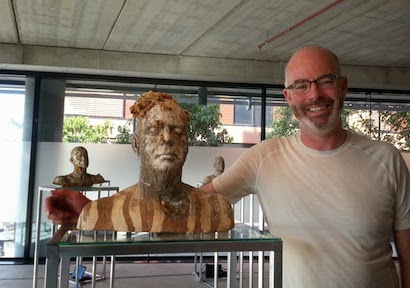
This conversation is taking place upon the conclusion of Michael Morgan’s exhibition ‘Impermanent Vessels – Rebirth’ (8 – 25 May 2014). The project is a milestone – not only for being his second major exhibition (the first was held in 2011) but also for bringing together his conceptual explorations in a new format – an immersive installation of sculpture and its interplay with digital imagery, video, sound, as well as smell.
Focused on the fragility and decay of all material things, the exhibition presented the recovered legacy of the 50 artist’s head casts in raku clay that were subjected to a year-long interaction with the environment of ocean water. Curating this exhibition was a unique experience for me and a privilege to follow the stages of the objects’ creation, placement and recovery.
Presently, Michael is working towards completion of a mosaic wall – the second of his thematic studio walls composed of cut out fragments of numerous dishes, tiles and kitschy souvenirs – modern but old and mostly unwanted representatives of the 20th century consumer culture.
The relative and overlapping formats of Michael’s work is painting, print, ceramics, mosaic, sculpture, and most lately – video. ‘Impermanent Vessels’ introduced his interdisciplinary practice engaged with physical processes.
More than the scale (which is often present in his work) – the honesty and directness were the qualities that first struck me about his art. It has estranged others. Indeed, the usual system of knowledge through which one tends to screen various modes of art expression seems to be irrelevant. Free from didactic, the essence of his work appears descriptive of reality, of idea. His ongoing focus–interrelationships of the human and nature is engaged with deconstruction of the intellect. The beautiful is always ambiguous in his work, and the dramatic always resonates with the beautiful. Our conversation touches some of the themes that informs Michael’s work – the issues of the human animal and the collective mind in the context of the globalized world.
 |
| A glass mosaic wall, in progress |
MB: The interesting feeling with your mosaic walls is that they appear as chaos of tens of thousands of elements and yet you have been using this chaos to create some order. Which is more prevalent for you – chaos or order?
MM: I am trying to create a rhythm. The only order that I am aiming for is energetic flows, and I am using different textures in different places of the surface, so that creates order, but even within that order there is a chaos.
MB: To what extent is it important to achieve a completeness of the image: if I look at the Tree of Life – its composition reflects wholeness, even a metaphorical representation of the universe.
 |
| "Tree of Life" mosaic |
MM: This [glass mosaic] is more like a complete portrait, here I am coming back to the Rorschach dream (an earlier painting using reflection symmetry of image around human figure – self-portrait – MB). Everything is reflective: I am wanting to mirror the images, use the principle of self-reflectiveness. You see bits of your own light reflected back off it. That interests me.
MB: Does this relate to the dynamics of fractals which you have been referring to as inspiration?
MM: Yes, the self-reflectiveness and patterns within patterns. I am not trying to create fractals, it’s about that process happening naturally. We create fractals unintentionally. It will be full of fractals and I didn’t intend that.
MB: So what you are dealing with is the natural order, natural rhythm?
MM: Yes, it probably is. Perhaps it is similar to what Jackson Pollock was exploring with an absolutely chaotic surface that developed a rhythm within it. Whether that was intended or not, it turned out to be incredibly harmonic way to generate images. I think this is what it is about – the harmony of the surface through the rhythm.
MB: What I see in the first place is the expression of the beautiful.
MM: True, I haven’t tried to make it an ugly thing, I have been aiming to make the wall into something like an Aladdin’s Cave. That makes the surface look quite precious I suppose – as a jewel cave.
MB: And there are some elements – jewels – that speak for themselves creating very special dynamics.
MM: Every part can be looked at in isolation. I am painstakingly working through each part – I can’t rush it. It is like painting a picture and just damping on one brush full of colour using an incredibly large surface. I love the textures and different types of surfaces. What I am working with is the energy.
MB: What would be the ultimate mosaic?
MM: I don’t know if there is an ultimate of anything. I think you are always just exploring, aren't you? If I could cover the whole house with this surface it would be fantastic. But even that will be just a step to something else. Even bigger. I have seen somewhere something about a mirror house – in landscape it becomes almost invisible – reflecting everything around it. I am doing it in my studio, so I am creating a space which also makes it interesting.
MB: What was the first interest for you – science or art?
MM: Probably, both. I have one bright memory from my childhood: I was lying and feeling this incredible vastness... That epiphany of the world and the universe I experienced when I was five or six – scared the hell out of me. I loved both those things – science and art simultaneously. Art and science are both about exploring the world by different means of experimentation. Maybe we get too much hang up on differentiating things, putting different labels on them and not understanding that everything is part of the same thing – ourselves and life. All these things are about being creative, whether you have a maths mind, a science mind or an art mind, but you are going to be bits of everything. Our knowledge is limited but that is what makes life interesting – you can explore your space.
MB: Is this what experimentation is about – being directed to truth?
MM: It is about curiosity and making connections. Maybe that is related to truth, but from my perspective I am attracted by reality. When I was young and was hunting with my father, I found it a very natural thing to be doing. When you are out in the wild, you see the animals and you also see dead animals, and you observe the way farmers work. In general, it’s a very practical approach to things – if the animal is sick, they put it out of its misery, they need to deliver a lamb – they deliver the lamb, they need to kill it to eat it – they kill it to eat it. The reality of nature can be quite brutal but I also found it amazing – such a small part in a vast existence. I was just thinking of the natural beauty of nature, and the truth about how things really were, not some contrived way people might have imagined it.
MB: We can assume the animals can sustain natural order in life, but if humans are involved, they can also manipulate nature and parts of it die out.
MM: They can, but you are straight away taking the high ground view that the humans are disconnected from the animal world, but we are not, we are part of it. It’s only when you become intellectual and moral about it that you start thinking about it differently.
MB: Right, so a human is just another form of animal with advanced brains…
MM: We think we have special brains but it does not seem to be that way. Today’s massive humanity suggests that it must have termite mind, and it is driven not just by food, but greed as well. Our collective termite mind is very animal-like, very herd, and easy to manipulate especially by politicians and media who use this mind.
MB: Obsession, passion, urge for power – is that what differentiates humans? We don’t strictly follow the rules of nature?
MM: The natural world is all about that power and control and that natural hierarchy about where you sit in the food chain and what dominance you have over someone below you. But as long as this system is founded on practical reasons it is not cruel. I don’t think animals are generally cruel to each other – they just do things out of the need for survival. Whereas, humans can be completely brutal, and there are huge contradictions [with nature] in that. They can be the most cruel animals in existence really – considering what they can do to each other. Fundamental to cruelty is apathy – an apathetic person doesn’t have any empathy to relate with another person: they just don’t bother.
MB: A lot of your paintings seem to refer to that human mentality: dark and unnatural sides of it that you use in an allegorical way.
MM: All my art is about the human condition, human impact, and human beauty. I explore different things that are relevant at a particular time, depending on what’s going through my mind, but it’s usually about how people are treating other people or how they are linked – as termite mind. I am interested in this unseen connection and how it creates morphic resonance – something that transmits through: one person comes to an idea, and the others come to that same idea. It is like ripples in the pond – it just goes out. Same generation, almost instantaneously. This knowledge goes to deeper understanding of nature and our place in the world. It could be positive or negative knowledge – any sort, say, some scientific breakthrough – suddenly it all makes perfect sense for everyone else.
MB: Is it the distorted evolution and utopian development called progress? Do you believe in it?
MM: I am not sure whether we might have real evolutionary change for ourselves – that might be intervention. Like the eugenic manipulation, for example. Progress… Progressing towards what? Complete extinction? More than likely – at some point. A big aspect of evolution is extinction. At this moment, all is driven by economic development. As long as they [politicians] keep talking about ‘sustainable growth’ – to me, it’s just emphasizing the inevitability of extinction, driven by short term views of politicians. They don’t need to think about a hundred years in the future as they are elected for few years.
 MB:
The tension between communism and capitalism is over but we continue to experience the negative sides of globalisation. How do you see the world’s ideological picture now?
MM: As extreme polarisation. Extreme Islamic philosophy – total simplicity and brutality towards people and the orgy of capitalism which, in the name of profit, exploits everything it has its hands on. It’s really just the opposite reflection of the actual extremes. The Islamic extreme philosophy is almost like an ultimate communism I suppose – all is controlled by Sharia Law, whereas, the capitalist governments quite clearly refer to Christian fundamentalism. When you hear about serious consequence of capitalism happening in, for example, the US – it is all seen in light of ‘god’s blessing’. Capitalism and extremism are gone insane. They make people powerless and defenseless, and I find that a scary progression towards the future.
MB: You have admitted having observed the cruelty of people, and being an outsider as a child paralleled your interest in art and science.
MM: Being an outsider is my earliest memory. I only had a few friends, and they were just as much outsiders as myself. I enjoyed doing things that other kids didn't generally enjoy – such things like art, hunting, and shooting. And when people knew you were hunting they were a bit confronted by that. My view was different – I didn’t think it was some cruel thing. In earlier generations it was understood that the whole purpose of having an animal is to consume it. Now people don’t like to have that direct connection, they just want to imagine things remotely. Someone kills animal in the factory and you just pick it up.
MB: Now people minds are influenced by various environmental protection movements.
MM: I think that this influence comes to making people feel guilty about existing and interacting with the environment. The whole agenda of any ideology is to make you feel guilty about being alive – so you change your way. Ideological figures instinctively go for that approach because it is quite effective. That’s a cruel way to treat people: by guilt or fear. Being aware of what’s unacceptable is one thing but then making you feel guilty is different.
MB: Economics is probably based on all that – guilt or fear.
MM: I suppose, it is how both capitalist system and Islamic groups –in fact all religious groups – are working. Catholicism is based on making you feel guilty about the original sin. It works quite well for religious groups, it works well for lobby groups too. It’s all about control.
MB: It is interesting when you think of us – humans as being same as animals. But inquiring about being, and, for example, making art – that is supposed to be only human ability.
 |
| Chemo Boys |
MM: I think we make ourselves too sophisticated. But we are just a very simple organism. Very frail – skin and bones, living organs, breathing lungs, beating hearts. Exactly the same as every other mammal. The collective mind of termites builds a termite mound – is that art? If you are trying to analyse the intellect of the termite – I don’t know if you can do it, but there are millions of them and they have the capacity to do amazing things. That’s why I find insects, like ants quite fascinating. I think that separating what is considered art is a superior view – it is just an innate need to express yourself, an instinct. Procreation might be art and all animals have forms of it. Not every human is born in the ideal way or perfection but this magnifies the animal instincts we have such as to procreate, to protect yourself. And probably the reality is that everyone is quite capable of killing in the right circumstances, purely to survive. Instincts have taken modern ways – which I realized as a kid by seeing that there were bullies and predators. The predators frightened me – some of them, the most dangerous ones, are almost invisible: they look for the vulnerable and are brutal in how they would take an advantage of them. Whatever the motives, predators are contradicting the nature. To me, it is natural to have networks of people who look after each other: when you are in a position to have a good influence on people, that’s easy, you don’t have to be cruel.
 |
| "Crystal Azan" time-lapse video still |
 |
Michael in his studio, working on "Impermanent Vessels" |