Showing posts with label Whitney Museum. Show all posts

Saturday, July 22, 2017

Exhibitions | A Torrid Summer Night at the Whitney Museum


It is another hot and humid evening in NYC with heat advisory warning and I have just received a cutthroat settlement proposal in my traumatic divorce. The Whitney Museum pay-what-you-wish evening hours are a literally refreshing alternative to my hot and sweaty day—literally and metaphorically. After all, art has always offered solace during troubled times.

Two different seemingly different exhibitions are on view at the Whitney Museum. The sixth floor is filled with "Calder: Hypermobility" a display of mobile sculptures by Alexander Calder (1896-1976). The American sculptor developed in the early 1930s a new kinetic art form, the mobile—a sculptural composition of suspended elements, often made of metal, finding balance in their own relational movements.  


Calder's mobile continued on the 3rd floor with the mobiles "performative" actions activated by Whitney's staff in "Small Sphere and Heavy Sphere" a recreation of the 1932-33 installation. The hypnotic movement of the found objects composition capture the audience for over twenty, eliciting, what I experienced as meditative state, which I greatly welcomed considering the stress of my day cursed by divorce matters. 

The fifth floor instead presents "Hélio Oiticica: To Organize Delirium" a retrospective of the Brazilian artist Hélio Oiticica (1937—1980). The exhibition spans from the early geometry based drawings and three-dimensional works to film and installation and participatory art, including Parangolés (wearable layers of fabric) and Penetrables (environments). The recreation of the large-scale environments "Tropicalia" and "Eden" are opened to the museum public as walkthroughs. Oiticica’s oeuvre, much involved in a political discourse, encompassed visual art, architecture, music, poetry, theater and film and was greatly influenced by the counter-culture scene of New York in the 1970s reflecting the several years spent by the artist in the city.


Finally the urban views from the museum terrace!

Saturday, January 9, 2016

Exhibitions | In the Name of Geometry: "Frank Stella: a Retrospective" at the Whitney


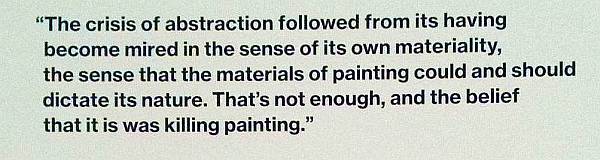
The rigorously simple yet majestic volumes of the fifth floor of the Whitney have been transformed in a feast of forms and colors, where geometric explorations are the connecting thread of the multi-scale and multi-media works. It the retrospective of Frank Stella’s work spanning over six decades of work of the American artist (b. 1936), one of the greatest examples of contemporary geometric abstraction.
Both the two-dimensional and three-dimensional works are at the crossover between art and architecture; the scale of the paintings and sculpture is such that the artworks transcend the boundary of the object to enclose surrounding space.


Some of the iconic paintings, characterized by band of colors defining geometric primitives, span over twenty meters, transforming the space of the galleries in a built homage to color and geometry. The three-dimensional work also seems to aim to a transformation of space, transcending the boundary of geometry to become installation art. In his sculptural work Stella  artist uses a diverse set of material, often found in industrial construction: fiberglass, bent metal sheets, steel tubing, perforated metal; more recently the often rough materials are combined with highly detailed 3D printed smaller components.


     The regular geometry of the painting evolves into the irregular forms of the three-dimensional works—yet driven by geometric foundation. Regular geometries reappear in the most recent three-dimensional work: Plato solids and Kepler polyhedra are source of inspiration for the 2014 large scale outdoor sculptures: Wooden Star 1  (570 x 570 x 570 cm) and the carbon fiber Black Star (520 x 520 x520 cm). Quite ironically the artist's last name "Stella" is the Italian word for "star".


     Missing from the exhibition is a “personal touch”: the process behind the works could have been included to define a fluid continuity between the final production and the creative impulse behind mediated by the many diverse media used by the artists, from physical actions to digital design and fabrication, in the fluid encounter between forms and materials.
    Yet the exhibition is so powerful and engrossing, a pure joy of colors and forms, which perhaps leaves the visitors with curiosity about the beauty of geometry.