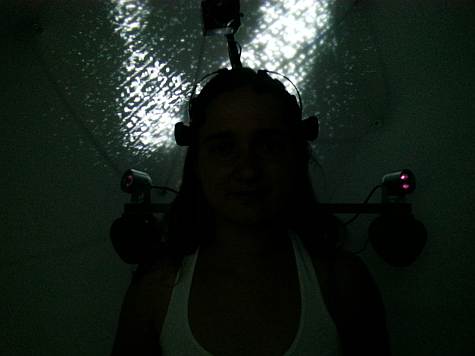
Zoe and I participated at the art installation "Mutual Wave Machine on June 17, at the 3LD Art and Technology Center: The Mutual Wave Machine is described as "an interactive neurofeedback installation
& neuroscience experiment that embodies the elusive notion of ‘being
on the same wavelength’ with another person through brainwave
synchrony. Enclosed by an intimate capsule and immersed in an
audiovisual environment that responds and reflects their shared brain
activity, two visitors can directly experience and manipulate their
internal efforts to approach or distance themselves from each other."
Showing posts with label EEG. Show all posts
Saturday, June 18, 2016
Sunday, May 31, 2015
World Science Festival | Sunday, May 31 "What Is Sleep?" and "To Explain the World"
Today was the last day of the "World Science Festival" and I attended two events which show the multifaceted aspects of the science showcased in these five-day marathon of the WSF.
The first event "What Is Sleep" took place at NYU Skirball Center for the Performing Arts, where Alan Alda introduced the five panelists, sleep expertsL Mary Carskadon, Paul Shaw, Robert Stickgold, Matthew Wilson. Each panelist is a researcher in different areas of sleep, and mainly with totally different subjects ranging from rats to fruit flies and...humans. While the experiments were understandibly very different, given the diversity of the subjects, the conclusions were similar: sleeping is crucial to the brain functioning and can help to restore memories and maximize our learning potential. The recommendations presented by the panelist, were quite inline with common sense: follow the circadian rhythms and slow-down before going to sleep.The aim was the detect recommendations presented by the panelist, were quite inline with common sense: follow the circadian rhythms and slow-down before going to sleep.
The centerpiece of the event was the live video observation of human subject, sleeping off-stage whose brainwaves were tracked by EEG. wired-up person sleeping offstage. EEG is a common tool to detect sleep activity as shown by studies ongoing for several years this experiments was not really adding to the educational and informational intent.
My other critique to this event, otherwise enjoyable and educational, was the lack of attention to sleeping disorders and problems, which are experienced by a large percentage of the world population; a summary of statistics and studies can be found in a webpage from the Center of Disease Control. Even if the event duration was only one hour, some time could been allocated to outline the main sleep problems and disorders as well as the treatment options and other related resources. Every healthy person is aware of the importance of adequate sleep, but how to achieve it often outside our control -or our free will, just to mention another popular theme of the WSF, To overcome the lack of information from the WSF event, below are a few useful sites:
- http://www.nlm.nih.gov/medlineplus/sleepdisorders.html
- http://www.ninds.nih.gov/disorders/brain_basics/understanding_sleep.htm
- http://sleepfoundation.org/sleep-disorders-problems
![]() |
| Screenshot of a polysomnographic record (30 seconds) representing Rapid Eye Movement Sleep. EEG highlighted by red box. Eye movements highlighted by red line. Retrieved on June 1 2015 from http://en.wikipedia.org/wiki/Dream#/media/File:Sleep_EEG_REM.png |
The other event concluding the five-day WSF marathon was "To Explain the World: a Conversation with Steven Weinberg", moderated by Peabody Award-winning journalist John Hockenberry and hosted by the New-York Historical Society. The conversation was based on the latest book “To Explain the World: The Discovery of Modern Science" written by the Nobel Prize-winning theoretical physicist Steven Weinberg, who also holds the Regental Chair in Science at the University of Texas at Austin.
Weinberg stated at the beginning of the conversation that "the standard model is not the end of the story" and introduced some of the differences between the classical Greek science and the Hellenistic practitioners, with mentions of Democritus, pre-Socratics, Plato's Academy, Aristotle. Some emphasis was to given to the work of Aristarchus of Samos (c. 310 – c. 230 BC), credited with the first heliocentric model.
The conversation was inspiring: Weinberg emphasized the importance of the unity of science and shared more personal details on his research activities. Weinberg, a New York City native and graduate of Bronx High School of Science, discovered the power of mathematics while understanding the equations behind the catenary of a bridge. He became involved in research at the Niels Bohr Institute in Copenhagen, which shaped his later studies in particle physics and quantum gravity. He was aware a Nobel prize in 1979 in physics jointly to Sheldon Lee Glashow, Abdus Salam "for their contributions to the theory of the unified weak and electromagnetic interaction between elementary particles, including, inter alia, the prediction of the weak neutral current".
I wanted to ask Professor Weinberg several questions which, due to the long line-up, were not answered:
- Are built construction of early observational astronomy (archeoastronomy) of relevance in the history of astronomy
- How he situates art in scientific discoveries? What is the role of beauty in science either in a theory formulation of in the geometric cosmological interpretation or configurations itself (e.g. galaxies form).
Both questions were derived from perhaps a vision of a cross-disciplinary approach to science, where art and science are integrated methodologies in the advancement of knowledge. A vision which perhaps was missing from many of the WFS programs, where art was a mere presentation/communication tool instead of a component of a scientific approach.
![]() |
| From the book cover of "To Explain the World: the Discovery of Modern Science" |
Wednesday, November 19, 2014
Creative Practice | Art Science Technology: Movement in Virtual Space
![]() |
| Framing movement in Cartesian Space |
La filosofia è scritta in questo grandissimo libro che continuamente ci sta aperto innanzi a gli occhi (io dico l'universo), ma non si può intendere se prima non s'impara a intender la lingua, e conoscer i caratteri, ne' quali è scritto. Egli è scritto in lingua matematica, e i caratteri son triangoli, cerchi, ed altre figure geometriche, senza i quali mezi è impossibile a intenderne umanamente parola; senza questi è un aggirarsi vanamente per un oscuro laberinto.
Galileo Galilei - Il Saggiatore (1623)
Movement is no exception to the mathematics of the universe described by Galileo. Geometric configurations are able not only to represent but also to inspire human voluntary movement sequences —and ultimately produce "positive" cognitive states. The correlation between voluntary human movement, space and mental activity comprise the topic of the creative practice of my doctoral research at Deakin University, titled "Form Mind Body Space Time".
As component of my research methodology, an original approach to the study of movement in the space of virtual environments began being tested on November 11 and 12. The physical facilities were located at PERCRO, the Perceptual Robotics Laboratory founded by Massimo Bergamasco and part of the Institute of Communication, Information and Perception Technologies (TECIP) of the Scuola Superiore Sant’Anna, right in Pisa, birthplace of Galileo.
The experiments involved the virtual environment of the XCAVE (based on the framework XVR developed at PERCRO and involved motion capture technologies and electroencephalography (EEG), using the 32 channel wireless G.Nautilus system from G.Tech. The PERCRO researchers involved include:
Michele Barsotti, PhD Student, EEG capture and Setup
Claudia Faita, PhD Student, Support
Alessandro Filippeschi, Postdoc, Motion Capture
Marcello Carrozzino, Ricercatore, Graphics
Emanuele Ruffaldi, Ricercatore, Graphics
![]() |
| Moving in a space based on combination of tori and cylinders |
![]() |
| Movement improvisations inspired by the hypericosahedron |
![]() |
| Testing motion sensors and wearing the EEG cap |
![]() |
| Moving in a golden spiral from the Fibonacci series —Leonardo Fibonacci was also born in Pisa! |
![]() |
| Finding a baseline: back to the Cartesian grid |
A video clip from the "Torus Meditations" http://youtu.be/VkrOgXbFZ4c?list=UULBmuY0cLF_b0xgCXF92Ebw
Wednesday, October 8, 2014
commentary on Nobel Prize in Physiology | I Walk, Therefore I Remember
![]() |
‘A’ Figure, from Ramon Llull's memory wheel “Ars Brevis”
(1617)
|
Hugo Spiers, director of the spatial cognition group at University College London, gives a summary of the relevance of these discoveries “Grid cells and place cells offer one of the few bridges neuroscientists have linking the cellular level to the cognitive level, as they help explain how individual brain cells help us navigate, remember the past and imagine the future.”
![]() |
| The Memory Theatre of Giulio Camillo from "The Art of Memory" (France Yates, 1966) |
![]() |
J. Publicius. Oratoriae artis epitome (1482)
|
Knowledge is one, methodologies are many
As a research artist I have been involved for years with movement, space and memory; one of my latest work "My Geospatial Self" the awareness of where we are in space and time, mapping places to thoughts of emotion. I constantly use my phone GPS as tool to record my presence in space and time in the ephemeral footprints of the encounter between myself and the surface of planet earth. I relentlessly take photos of trying to find beauty or whatever aesthetic commentary in everyday life encounters of places and people, in the social or natural environment. I am sure that something happens to the neurons and synaptic connections of my brain, even if I cannot document it. My walks creates memories and promote healing from emotional pain and stress. And I am satisfied with it, even if will not bring a Nobel prize.
![]() |
| My "mind walk" wearing a EEG headset, on October 3, 2014, Hudson Waterfront, New York |
Subscribe to:
Posts (Atom)


.jpg)