Showing posts with label Dance. Show all posts

Tuesday, August 26, 2014

summertime | In, Out & About: Hudson Valley

A solarized view of the Taconic Parkway, the infrastructure of my weekend getaways
Summer is slowly, yet relentlessly, fading away and I am posting a few of the visual memories of the places and events I have been intersecting with. Photography has become a storytelling medium and the narrative is increasingly expanded to include some vertical panoramas where backbending aids in framing the composition.
Framed views of an opening at John Davis Gallery in Hudson


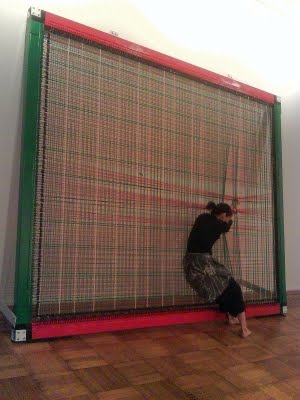
Walking while interacting with dancers in the Fields of Art Omi
Suspended whales in the industrial archaeology of Basilica Industria, reminiscent of the Hudson past
A view of the Huson river with the Catskill Mountains background
Warren Street, Hudson

Friday, December 30, 2011

Movies | "Pina": Life as Dance


Dance as language or celebration of movement is not new and there are countless movies on dance. So I am wondering and trying to answer what made the movie “Pina” so special and memorable. Pina” is a 3d film/documentary of several performances of the late Pina Bausch “Tanztheater” The director Wim Wenders is one of the most profound storytellers of cinema and in his movies images tell stories as much as words. In “Pina” Wenders’ visual poetry makes compelling use of the 3d format. Not new, as 3d movies bring space to a 2d flat medium, the projection screen; often the architectural features of sets —thinking of the other remarkable feel good 3d movie “Hugo” are greatly enhanced by the 3d technology. But in “Pina” besides the set is the movement of the dancers’ bodies through space which becomes quite compelling experience for the viewers. From the simplest step to the most acrobatic jumps and falls the viewers feel surrounded by the energy of the larger than life dancer’s bodies, often emphasized by the lighting.
And of course Pina Bausch’ choreography makes the visual story captivating. Her work is defined a contemporary form of Tanztheater ("dance theatre"), the expressionist dance developed in Germany in the 1920s. The vocabulary is based on movement as expression, in contrast with ballet or other structured forms of dance, leading to a fusion between dramatic and rhythmic movement. The use of props is another important element of the performance: the dancers interact with chairs, sand, ropes, veils, water almost as extension of their body. Beauty often derived from the lyrical abstraction/presentation of otherwise ordinary objects or simple movements of daily life. In Pina dance is a component of daily life, as the set design goes beyond the stage to expand in a wider context of real places, either urban or landscape, offer the set. Dancers perform in the Schwebebahn (floating tram) of Wuppertal or in highways; any place can offer a pretest to express “joie de vivre” or any other feeling —quoting Matisse another visual artist who was intrigued by “la danse” as expression.

The story is also told through a few words from the dancers of Pina’s Wuppertal Tanztheater: besides their interaction with the charismatic choreographer, they reveal their life in a dance company as a greater community —perhaps utopian. The dancers span different generations making a statement that dance, at least in Pina’s world, is ageless.

And beauty and celebration of life can be found and expressed everywhere.
pina
dance dance otherwise we are lost

Monday, July 18, 2011

performances | Elizabeth Streb - On the Fly

It’s hard to swing a new handbag without hitting an Elizabeth Streb performance on the streets of Manhattan this month……..and I mean that in the warmest and most supportive way. Choreographer Streb is daring, energetic, and goes way beyond the image conjured up as “dance’. Her performers fly through the air with the greatest of ease….. off high platforms and scaffolding in mind-bendingly athletic performances.

Along with this past weekend’s Battery Park event, “Human Fountain”, by the Streb dancers, the previous weekend found them in Gansevoort Plaza with their new work “Ascension”, commissioned by the Whitney Museum to highlight the museum’s new site being constructed nearby at the HighLine.
“Ascension” revolved around a 20 foot rotating ladder the nine performers ran up, down and catapulted off, in a perfect execution of the strength and skill of Streb’s troupe.

Streb, Inc tours throughout the U.S. and Internationally. Streb Lab for Action Mechanics resides in Williamsburg, Brooklyn.
Fearless leader, Elizabeth Streb, was awarded the MacArthur Foundation Genius Award in 1997. She is a tour de Force in action and mind.
Make a note on your latest techno-calendar to attend Streb’s Park Avenue Armory event, “Kiss the Air” in the Armory’s huge Drill Hall, December 14th – 22, 2011. For information and ticketing go to armoryonpark.org.
Two pertinent videos to watch:
ASCENSION and Elizabeth Streb discussing the performance.

Saturday, June 11, 2011

camminando NYC | Walking the Line and Encountering a "Roof Piece"


The High Line hosted the recreation of Trisha Brown Dance Company's "Roof Piece" on its 40th anniversary.
Ten dancers performed on different rooftops surrounding the southern end of the High Line, mimicing each other's improvised movements.
The northern end of elevated park also just opened. It was a lovely evening, in a successful, although unusual, marriage between industrial archeology and nature.


The new High Line extension celebrated by AOL with inflatable sculptures

Wednesday, March 30, 2011

Events NYC | Eiko & Koma: Moving to Stillness

Dance is often thought as movement; usually as a series of movements performed by dancers on a stage in front of an audience. In modern, and even more so, in contemporary dance, the traditional setting of a dance performance are often challenged. This is definitely true for "Naked: A Living Installation". The title itself signs a departure from the traditional dance performance. Stillness and the relationship with time is one the main experiences evoked by this work by the Japanese-born artists Eiko & Koma. I believe that the definition "artists" ---as comprehensive of many forms of expression and media--- is more appropriate than dancers. Although the body is the main, but not only, expression medium in Eiko & Koma work.
So the performance setting is not typical of "dance": canvas enclosures with feathers, hair, straw. Holes are punched in the canvas allowing the viewer to peek into the performance space, where Eiko & Koma lie naked, with their body painted white. There is an almost complete absence of movement and the viewer is induced by the stillness almost in a meditative state.

Naked studio shot: photo by Anna Lee Campbell


"Naked" was created for and commissioned by the Walker Art Center in Minneapolis, where it premiered in 2010.
It will be on view at the Baryshnikov Arts Center (BAC) through Saturday, April 09, 2011
For more information visit Eiko & Koma site

Saturday, April 24, 2010

Vernissages + Performances | NYC, Jack Tilton Gallery and Martos


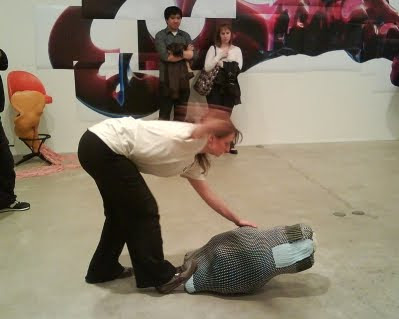
Spring has finally arrived in NYC and a new energy seems to renew NYC visual arts. Dance performances harmoniously merge with art installations at two art galleries ---Martos in Chelsea and Jack Tilton in the Upper East Side--- with a remembrance of the 60' happenings

Probably the most outstanding intervention in terms of site-specificity happened yesterday at Jack Tilton's gallery where Malcolm Low's choreography beautifully interacted with Jarbas Lopes's sculptures. The Brazilian artist's sculptures are based on functional objects such as bicycles and bungee chords in "a celebration of life, art and movement".


Malcolm Low's dancers at Jack Tilton's

Patricia Weiss at Martos Gallery

Friday, September 25, 2009

Blue Rider


Four dancers from Armitage Gone! accompanied the Brentano String Quartet last evening at the opening of the Miller Theater at Columbia University.

Leonides D. Apron, Megumi Eda, William Isaac, and Mei-Hua Wang danced in pairs with the second movement of Schoenberg’s String quartet no. 2. The music floated by. The pairs went their separate ways from it, as well as from each other, EXCEPT when the females assumed angry faces and made physical, ward-off connections with each other. The movement was brisk, with lots of very skillful arm and leg motions. The stage was heavily-darkened. The performers wore dark clothing, although the dancers' transitioned from dark on the bottom to gray on top.

The concert titled The Blue Rider in Performance was produced by the Miller Theatre and Works & Process at the Guggenheim, using materials from Vasily Kandinsky and Franz Marc’s seminal Blue Rider Almanac of 1912.