Showing posts with label Triadic Ballet. Show all posts

Friday, April 12, 2019

Bauhaus Centennial

The Bauhaus logo

"The ultimate goal of all art is the building!" is the first sentence of the Bauhaus manifesto. 

The German school Bauhaus (literally translated as "building house" () was founded in Weimar by Walter Gropius in April 1919 and was operational until 1933. The main philosophy was about design as an interdisciplinary practice involving architecture, painting, sculpture, performing arts, graphic, industrial and interior design and typography. The notion of Gesamtwerk ("total work") and Gesamtkunstwerk("'total' work of art") was informing any methodology and product.

The manifesto continues with enthusiastic appreciation of craftsmanship 
So let us therefore create a new guild of craftsmen, free of the divisive class pretensions that endeavoured to raise a prideful barrier between craftsmen and artists! Let us strive for, conceive and create the new building of the future that will unite every discipline, architecture and sculpture and painting, and which will one day rise heavenwards from the million hands of craftsmen as a clear symbol of a new belief to come. 
Architects, sculptors, painters—we all must return to craftsmanship! For there is no such thing as “art by profession”. There is no essential difference between the artist and the artisan. The artist is an exalted artisan. Merciful heaven, in rare moments of illumination beyond man’s will, may allow art to blossom from the work of his hand, but the foundations of proficiency are indispensable to every artist. This is the original source of creative design. 
 The Bauhaus has provided great inspiration for my interdisciplinary practice Space Ink integrating art, architecture and design at different scales, merging physical products with computing methodologies. My work with performance art also finds references in Oskar Schlemmer, another great Bauhaus master.

Google Doodle also celebrates the 100th anniversary of the Bauhaus movement.


Eva Mueller's Bauhaus Tattoo 


.

Friday, November 29, 2013

Research Excerpts | The Bauhaus Gesamtkunstwerk


In the past week my research was inspired by the Bauhaus notion of gesamtkunstwerk  (total work) which emerged from my subconscious or art and architecture history; I was surprised that this inspiring and relevant precedent did not appear at earlier stage.  The Bauhaus had an organic synergetic approach to design and the gesamtkunstwerk included architecture, visual and performing arts, as well as crafts. The concept is best expressed in Walter Gropius' introduction to Die Bühne im Bauhaus (The Theatre of the Bauhaus) by Oskar Schlemmer, László Moholy-Nagy, Farkas Molnár

...the Bauhaus embraced the whole range of visual arts: architecture, planning, painting, sculpture, industrial design, and stage work. The aim of the Bauhaus was to find a new and power- ful working correlation of all the processes of artistic creation to culminate finally in a new cultural equilibrium of our visual environment. This could not be achieved by individual withdrawal into an ivory tower. Teachers and students as a working community had to become vital participants of the modern world, seeking a new synthesis of art and modern technology. Based on the study of the biological facts of human perception, the phenomena of form and space were investigated in a spirit of unbiased curiosity, to arrive at objective means with which to relate individual creative effort to a common background.  


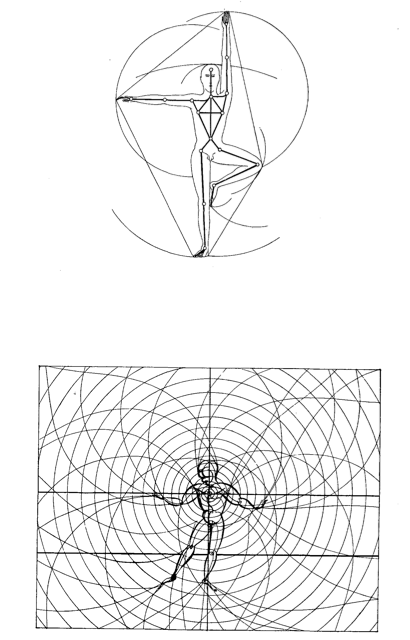
I find a lot of overlapping between the focus of my research on the geometry of movement and Oskar Schlemmer's studies on the geometric definition of human body and space, often expressed in the design of costumes. I found also this description very relevant to my research (p. 91)


...man remains perforce our essential element. And of course he will remain so as long as the stage exists. In contradistinction to the rationalistically determined world of space, form, and color, man is the vessel of the subconscious, the unmediated experi- ence, and the transcendental. He is the organism of flesh and blood, con- ditioned by measure and by time. And he is the herald, indeed he is the creator, of possibly the most important element of theater: SOUND, WORD, LANGUAGE. 

Costumes are body extensions to space and create forms which integrate both. The 1922  "Triadisches Ballett" is probably the most inspiring work: geometry informs both the human body and pattern of movement:


Text  excerpts and images from: 
Schlemmer, Oskar, L. Moholy-Nagy, and F. Molnar. "The Theatre of the Bauhaus (Middletown, Conn." (1961).