“What Does the Brain Do? Questioning Perception, Consciousness, and Free Will” was the title of a debate taking place at the Institute for Public Knowledge (IPK) of NYU, as part of the “Walls and Bridges” series by Villa Gillet —one of the many events on neuroscience presented to a general audience which are recently quite frequent in NYC.
The debate was announced as “Neurosciences can provide unexpected insights into free will by questioning how we see, hear and feel. To what extent do our decisions, thoughts and actions depend on our perceptions? Perhaps the best way to understand what the brain is doing is by studying what happens when it breaks down.”
Such an important title immediately attracted my attention, although I felt dubious that such extensive topics could be explored (even if only surfaced) in a two-hour presentation. In fact in the debate there were not too many references to consciousness or free will. Yet I found very interesting some of the presentation focusing on abnormalities in perceptions and how reality can be experienced very differently by people with major problems in visual perception.
Oliver Sacks’s presentation focused on loss of stereoscopic vision. Sacks, a neurologist physician and professor of neurology and psychiatry at Columbia University Medical Center, has recently published a book “The Mind’s Eye”, where he writes about being diagnosed with a rare eye tumor which caused loss of vision on his right side, therefore his stereoscopic vision, which enables the perception of depth. Dr. Sack had to learn to compensate his loss of by adapting to move in a “flat” world and experienced how perceptual problems bring major loss of functionality.
The neurobiologist Susan Barry lived through an opposite experience (from a two-dimensional to a three-dimensional world) belongs to: crossed-eyed from early infancy, she lived in a flat world until when as an adult she regained stereoscopic vision. In her presentation she mentioned the quality of cognitive conscious experience and how the perception of space can be altered. The perception of solid and void was distorted as one of the most basic experiences we give for granted, such as looking ourselves in the mirror or watching the snow falling.
Leaving the event I thought of Flatland: A Romance of Many Dimensions the 1884 novel by Edwin Abbott Abbott, the fantasy of a two-dimensional world (Flatland) inhabited by geometric figures and narrated by a square: a geometric definition of world is so much part of our daily life, either we are aware or not…
PS I dealt quite extensively with the topic of stereoscopic vision in digital visualization and “virtual reality” in my 1996 book “Designing Digital Space”

Tuesday, April 12, 2011
Sunday, April 10, 2011
Thoughts | The Faces of Facebook


I am a "minimal" user of Facebook and did not watch the movie The Social Network until last night; but I have to admit that is one of the few recent movies which made me think...and that does not mean that a thought provoking movie is a "great" film.
According to Wikipedia "Facebook (stylized facebook) is a social networking service and website launched in February 2004, operated and privately owned by Facebook, Inc. As of January 2011, Facebook has more than 600 million active users. Users may create a personal profile, add other users as friends, and exchange messages, including automatic notifications when they update their profile." It is definitely hard to describe a social phenomenon involving over 600 million people and The Social Network is clever enough for not exploring or making a commentary Facebook as a social phenomenon. Too much to say about it and the topic is more material for a documentary than a feature movie.
The main character is Mark Zuckerberg, the creator of Facebook and the movies becomes in 2003, when he was attending Harvard. From the very first scene he appears very clumsy, speaking extremely fast and often making unusual eye-contact; even his body seems to be disconnected from the “physical” social context. The camera is often on Mark typing with great speed on his laptop, absorbing him more than the world around. Mark’s social life mainly happens through the world from the screen/window of his laptop; but communication is very seldom personal and one to one, such as with email, text messaging or chats, but it happens through blogging, hacking, and insinuating into Harvard computer network. The social context of Mark is populated by college students circles, fraternities and sororities, something quite scary to watch for somebody like myself, who attended to a large university in an European country during a time when students where still dreaming of making the world a better place —which does not mean that we were actually trying. The movie also portrays the majority of women surrounding Mark —college students as well—as “accessories” without a strong role in the main actions of the boys, often merely their sex objects. With the exception of Erica, the girl with whom Mark has a confrontation in the first scenes and was involuntarily the catalyst in the creation of Facebook. None of the other characters inspire sympathy: self absorbed and privileged, spending their college years either getting high at parties or immersed in their computer world: there is no search for beauty or knowledge, no deep emotion.
Virtual worlds are fascinating and often become shelter from the ugliness of the physical world, so is the beauty of number in the poetry of the code —yes, I have experienced it so many times! But in the characters there is no interest in the fascinating, sometimes dark or even disturbing immersion in imaginary virtual worlds —thinking of the early literature of William Gibson “Neuromancer” (1984) or Neal Stevenson’s “Snow Crash” (1992).
But the movie flows and captivates for almost two hours. Perhaps its most interesting feature is right in presenting the main character as a great example of our culture in its contradictions: an hacker disconnected from a social context becoming the emperor of a social network involving more than 600 million…no to mention his personal wealth estimated to $13.5 billion. And finally my question: the Internet has completely transformed that way we work, we travel, we shop, we read, we study, we make business, but how could have so distorted one of the most important human relationships, friendship?


Events | Celebrating National Poetry Month

According to an essay by David Orr (“O! Poetry,” The New York Times Book Review, March 17, 2011), “ …poetry can’t approach mass culture with any sense of swagger.” Orr was referring to the April 2011 issue of The Oprah Magazine: “Spring Fashion Modeled by Rising Young Poets.”
Most poets, however, don’t have to worry about outfits or about how to extend poetry beyond the literary culture so that it reaches Everyman - because there is National Poetry Month to bring poetry home, at least in April, all springing buds being equal.
National Poetry Month is a movement begun in 1996 by the Academy of American Poets. Its mission is to foster an appreciation of poetry within the popular culture, and the Academy advocates ways in which this may be done: put a poem in your pocket, chalk a poem on the sidewalk, attend a poetry reading or festival, enclose a poem with your letter, memorize or recite a poem, and, of course, buy poetry books and poetry broadsides.
To become acquainted with broadsides, for example, you may wish to view “Seduction,” the first series of four broadsides, wrought as a collaborative effort between poet Irene Mitchell, and artist Daniela Bertol.
There is also that increasingly captivating aspect of poetry, its connection to the visual, or “visual poetry.” You are invited to view excerpts from the visual poem, “Venice of the Mind.” The the video is by Daniela Bertol, the text by Irene Mitchell.
Irene Mitchell


Friday, April 8, 2011
Vernissages | NYC Chelsea , April 7
Symbols, organic geometries and earth forms: in a nutshell these are my reactions to tonight walkabouts leading to Arnaldo Pomodoro's "Continuum" at the Marloborough Gallery and Tom Doyle's "Space Embraced" at Sundaram Tagore. The title itself of both exhibitions surely tell stories, and my visual memories are below, to be continued...


 Arnaldo Pomodoro "Continuum"

 Tom Doyles "Space Embraced"


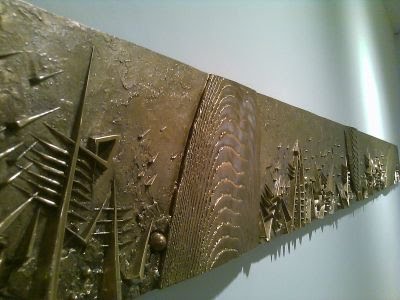 Arnaldo Pomodoro "Continuum"

 Tom Doyles "Space Embraced"
Thursday, April 7, 2011
Vernissages | NYC, Haresh Lalvani, XtraD

Buck House presented XtraD an exhibition of Haresh Lalvani sculptures exploring complex geometries at the intersection between art and science. The outstanding metalwork was realized at Milgo Bufkin.


 The art and dance critic Sunil Kothari
camminando | NYC Uptown: Public Art and the Art of Trees
A rainy unlikely spring evening yet offers opportunities for a celebration of the poetry of NYC streets. My walkabouts took me to a deserved visit to uptown urban / landscaped beauties, including an encounter with an important work of public art, by my friend artist Al Miller.
Paying my usual photo homages...

 A view from above: Morningside Park
 An unlikely almost deserted Malcolm X Boulevard


 Public Art: Frederick Douglass Circle

Paying my usual photo homages...

 A view from above: Morningside Park
 An unlikely almost deserted Malcolm X Boulevard


 Public Art: Frederick Douglass Circle

Excerpts from the conceptual multimedia project
“Axes Mundi: Perceptions and Understanding of Places as Intersections of Space, Time and Culture"
Monday, April 4, 2011
camminando | sun setting on the Hudson in a spring evening
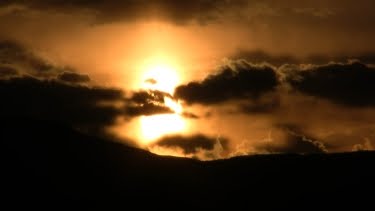


Excerpts from the conceptual multimedia project
“Axes Mundi: Perceptions and Understanding of Places as Intersections of Space, Time and Culture"
Poetry | BLUE RIVER by Gavin Keeney
BLUE RIVER
A blue river stretches
In the imagination,
Vast and preternaturally blue,
To the sea and what
Cannot be seen,
Broad- and island-soaked,
And as still as time
Before time.
Crossing its waters,
Floating on air,
Drifting with its current,
We traveled slowly,
Swept by the blue expanse
Toward eastern suns,
Two white slippers
Floating mid-river,
Idling in the cold breeze,
Cloudlike.
I have no idea
Who you were,
My fellow traveler
On this blue river.
I awoke to tell another
This tale.
To describe this blueness,
Of its wild-open trail
And silent depths,
Of its emptiness
And its woodland shores.
At first we were standing
At the forest edge
Wondering at how
To access this marvel,
To follow its blue
And full horizon,
To travel its length
And enter its breadth,
A blue and depthless
Path through forests,
Peopleless lands,
Below azure skies.
No one was out
Drifting aimlessly,
No fellow travelers
To be seen.
And what transported us
On this limitless current
Was invisible,
Or but a breeze.
No boat and no sail,
Two slippers idling
At midstream
Were the only sign of
A human presence –
Signature of the solitary.
Yet two, not one,
And as slight as paper.
A dream from some
Primordial shore,
And journey made
Or underway.
This royal river
Of vast expanse
Turned and flowed
Toward a sea
Unseen and surely
Unknown to eyes
That sailed the momentary
Measures
Of time itself
Before time was made –
Between bejeweled waters
And the azure sky.
GK (03/27/11)
Subscribe to:
Posts (Atom)